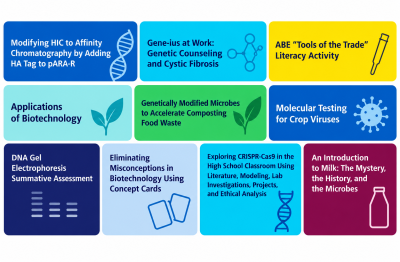
The 2024–25 ABE Master Teacher Fellows have turned their interests and ideas into a new collection of resources for the ABE community. Developed over the course of the year-long Fellowship, the projects reflect the Fellows’ diverse interests and expertise, with topics ranging from CRISPR-Cas9, genetic counseling, and crop viruses to biotechnology literacy, food waste, and the science of milk. Created by experienced ABE educators from Australia, Canada, Ireland, The Netherlands, Türkiye, Greater Los Angeles Area, Rhode Island, and San Francisco Bay Area, the resources are designed to support biotechnology teaching and learning and can be used alongside or as extensions to existing ABE modules.
Learn more about the 2024–25 Master Teacher Fellows.
Master Teacher Fellow Published Resources
Image

| Modifying HIC to Affinity Chromatography by Adding HA Tag to pARA-R In this advanced biotechnology unit, students explore commercial protein purification techniques by engineering a plasmid to include a hemagglutinin (HA) affinity tag for red fluorescent protein (RFP). Through a blend of bioinformatics, primer design, and molecular biology techniques, students simulate and perform the steps needed to create a tagged protein ready for purification using chromatography. |
Image
| Gene-ius at Work: Genetic Counseling and Cystic Fibrosis In this unit, students step into the role of genetic counselors to explore the inheritance and ethical implications of genetic diseases, using cystic fibrosis as a case study. |
Image

| ABE “Tools of the Trade” Literacy Activity This activity guides students through a biotech-focused literacy activity. Through model texts, collaborative writing, and independent practice, students build confidence in scientific writing while exploring tools like micropipettes, PCR, gel electrophoresis, and restriction enzymes. Designed for flexibility, the lesson also strengthens literacy, scientific vocabulary, and communication skills within real-world biotech contexts. |
Image
| Applications in Biotechnology In this unit, students explore real-world applications of biotechnology. Through hands-on use of techniques such as PCR, gel electrophoresis, and bioinformatics, students learn how biotech is relevant to their lives. Students complete the unit with a self-directed research project, applying their understanding to modern challenges in health, agriculture, the environment, or a topic of their choice. |
Image
| Genetically Modified Microbes to Accelerate Composting Food Waste In this unit, students investigate how microbes are harnessed in modern waste management systems and connect that knowledge to techniques used in the Foundations of Biotech Focus on Bacteria lab sequence. Through maintenance of a classroom compost pile, students also learn about the processes of nitrogen fixation and nutrient cycling. |
Image
| Molecular Testing for Crop Viruses This unit, Molecular Testing for Crop Viruses includes five lessons that provide theoretical and hands-on applications to understand plant-virus-vector relationships that enable scientists to design resistant plant varieties, develop diagnostic kits, and implement more-effective pest management strategies. Students implement PCR to amplify aphid and viral-specific genes from plant extracts and then gel electrophoresis to visualize PCR products and identify affected plant samples. Primer descriptions, PCR methods, and example assessment questions are included! |
Image

| DNA Gel Electrophoresis Summative Assessment This lab and assessment evaluate students’ abilities to perform and analyze DNA gel electrophoresis. Students use micropipettes to load DNA ladder and unknown samples into an agarose gel, run the gel, and then calculate Rf values; plot a standard curve; and use extrapolation and line-of-best-fit equations to estimate the molecular size of unknown DNA fragments. |
Image
| Eliminating Misconceptions in Biotechnology Using Concept Cards In an age of misinformation and disinformation, students need critical-thinking skills and a strong understanding of fundamental scientific concepts. This unit uses concept cards to identify and address common misconceptions in biotechnology. Through visual, interactive, and discussion-based activities, students build their understanding of key concepts, including DNA, genetic engineering, GMOs, PCR, gene therapy, and bioethics. |
Image

| Exploring CRISPR-Cas9 in the High School Classroom Using Literature, Modeling, Lab Investigations, Projects, and Ethical Analysis This unit introduces students to CRISPR-Cas9 gene-editing technology through a combination of literature, modeling, interactive lab investigations, bioinformatics, and ethical analysis. Students explore the molecular mechanism of CRISPR, compare it with other genetic techniques, and investigate real-world applications and ethical considerations through case studies and discussions. Designed for diverse learning levels, the unit also integrates career exploration and hands-on projects to deepen understanding and engagement with cutting-edge biotechnology. |
Image
| An Introduction to Milk: The Mystery, the History, and the Microbes In this engaging seven-part series, students explore concepts in biotechnology, biochemistry, and microbiology, through hands-on learning including both Bradford’s and Benedict’s assays. They investigate milk’s cultural significance, common microbes, chemical composition, and more. The author emphasizes that this lab series is highly flexible, providing an excellent learning experience for new and experienced learners alike! |